

High-performance computing · Physical AI · 2025–2026
200,000 worlds.
One question:
How does intelligence find freedom?
Planta Smart Homes used the Deucalion supercomputer to investigate how different observers perceive and navigate the same world. The result is a new foundation for contextual AI, spatial intelligence and the future of programmable private property.
2025.00020.AIVLAB.DEUCALION · Deucalion supercomputer · FCT/FCCN · RNCA AIvLAB
Observer-dependent context
Same topology · Weighs distortion against progress. Finds lighter paths.
Private Property Smartness
Intelligence that belongs to the property.
A private property is more than a collection of connected products. It is a bounded physical world with its own geometry, resources, risks, rhythms and possibilities.
Private Property Smartness gives that world the capacity to perceive itself, coordinate locally and act in the interest of the people inside it.

Context before data
Data is a trace.
Context is the world producing it.
A temperature value is data. Context includes the sunlight entering the room, the person approaching the window, the air moving between spaces, the energy available and every action the property can still take.
PlantaOS begins with relationships and possible paths. Data becomes evidence inside a living spatial model.

1 layer combined
LLMs read tokens.
Properties read worlds.
The next leap in AI comes from grounding language models in real context: geometry, causality, constraints, ownership, time and available action.
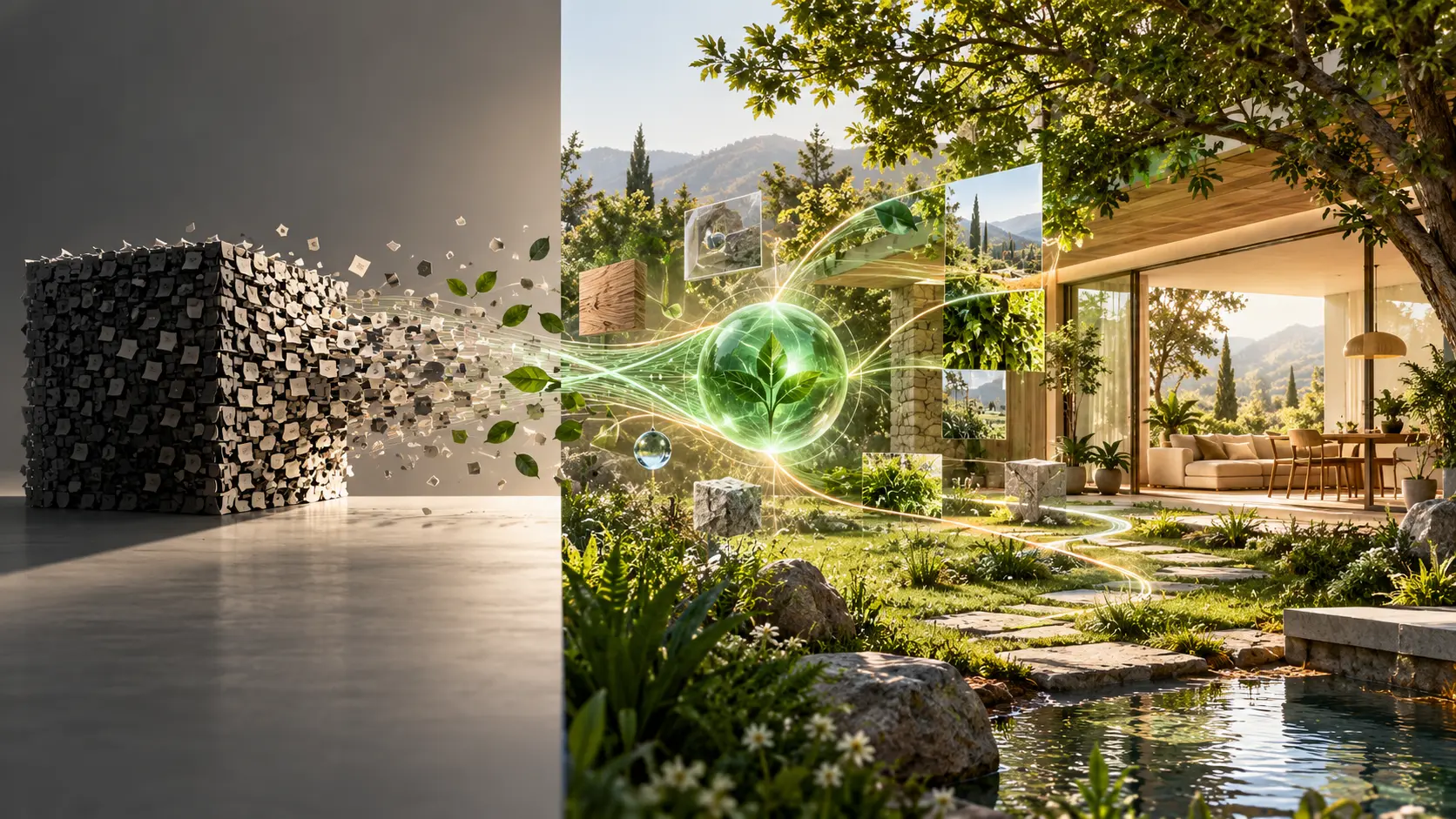
Disrupting LLMs through context
From language model
to world model.
01
Language
The LLM interprets requests, goals and descriptions.
02
Context
PlantaOS reconstructs the current state of the property and the relationships shaping it.
03
Paths
AFI evaluates available actions and their distortion across time, energy, risk and coordination.
04
Physical action
The property adjusts systems, openings, energy flows and eventually matter itself.
The LLM proposes. Context constrains. The property decides and acts.
Conventional LLM
Contextual Physical AI
Programmable matter · FLRP
The room becomes the interface.
Programmable matter turns intelligence into physical possibility. A wall can become an opening. A surface can become furniture. A boundary can expand accessibility. Architecture becomes capable of responding at the scale of matter.

Perceive
The room reads people, light, air, sound, movement and intention.
Research frontier: programmable architectural matter governed by contextual spatial intelligence.
One research programme.
Multiple paths into physical intelligence.
Project 01 · Direct Deucalion output
Observer-Dependent Navigability in Swarm Intelligence
How different agents perceive and navigate different possibilities inside the same world.
57,518 valid graph-navigation trials · R² ≈ .82 for behavioural alignment
Public preprint · Simulation research
Project 02 · Post-Deucalion synthesis
The Architecture of Freedom Intelligence
A design theory of intelligence based on perceived paths, distortion and observer-dependent freedom.
Research synthesis
Project 03 · Mathematical framework
Spatial Freedom Fields
A computational framework for representing how available paths change across physical and algorithmic space.
Theoretical and simulation framework
Project 04 · Applied physical AI
PlantaOS: Private Property Intelligence
A spatial operating system that joins people, rooms, energy, sensors and possible actions into one contextual model.
Applied research and product direction
Project 05 · Research frontier
FLRP Programmable Matter
A future material system capable of reorganising architecture around available paths and human freedom.
Long-term research frontier
Project 06 · Contextual AI
World-Grounded LLMs
Language models connected to geometry, causality, ownership and physical action through PlantaOS.
Active research direction
What survived the simulations?
Strong signal
R² ≈ .82
Behavioural alignment strongly predicted efficiency in synthetic graph navigation.
Context dependence
6 navigation strategies
The same environment produced radically different navigability for different observers.
Emergent coordination
87% improved
Ant-colony systems increased alignment as collective search developed.
Falsified path
R² ≈ .0002
The original multiplicative FLRP formulation produced almost no explanatory power.
The research changed the theory.
Deucalion supported the importance of path relationships while forcing a revision of how perception should be defined. The project became stronger through falsification: intelligence appeared less like a quantity stored inside an agent and more like alignment between an observer and its possible world.
Research model: Freedom = Perceived Paths / Distortion — a working hypothesis, not a proven universal law.
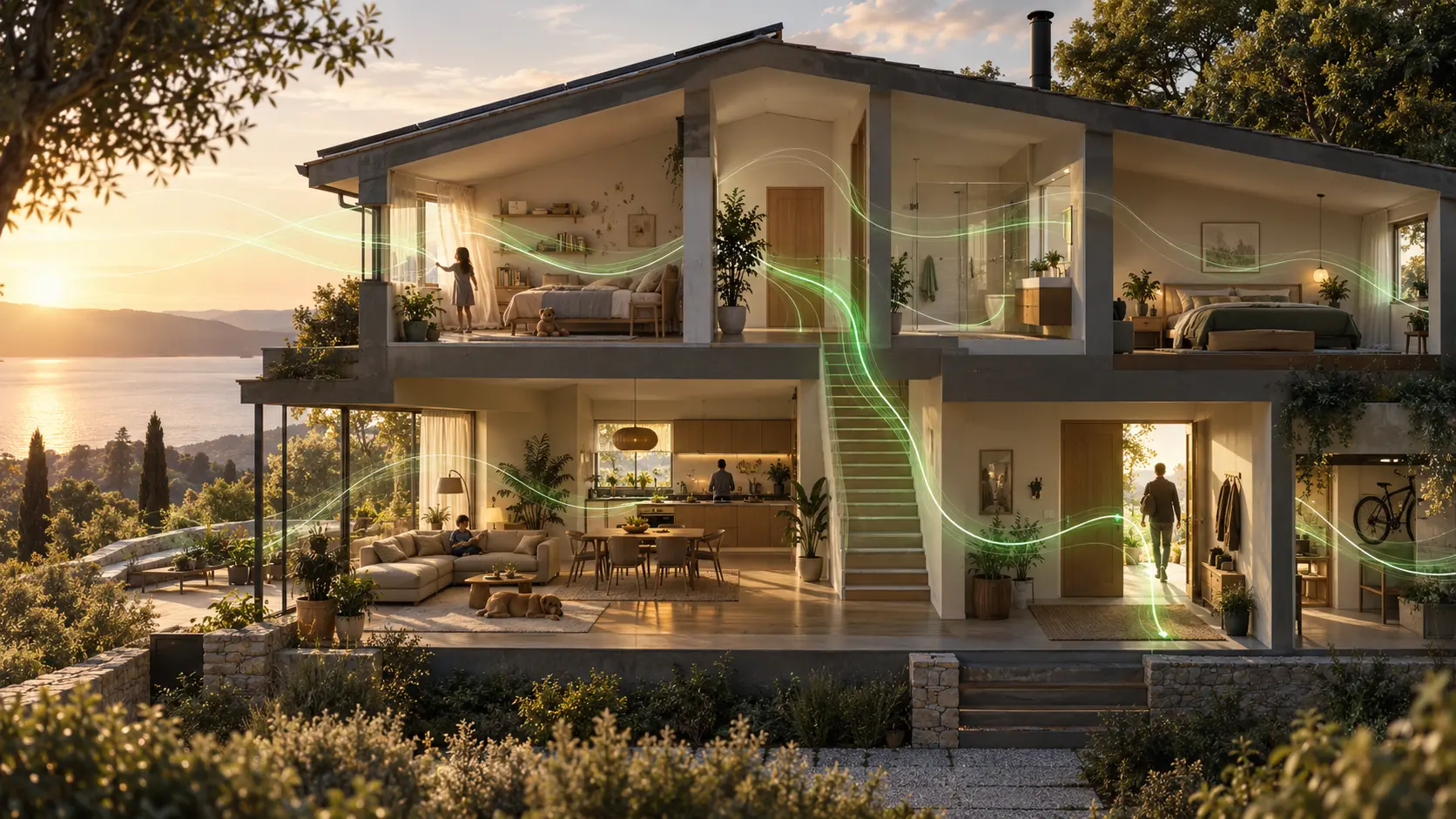
A smart home controls devices.
An intelligent property changes possibilities.
Planta Smart Homes is building toward private properties that perceive context, protect their intelligence and reshape physical space around human freedom.
hi@planta.design